Try the Aqueous Watercolor Nail Trend for the Serene Spring Manicure
A fluid look that carries the season’s light.
The scent of salt air meets the cooling sand of a late afternoon shoreline. You watch the way the tide pulls back, leaving behind intricate, swirling patterns of seafoam that vanish as quickly as they appear. There is a particular kind of peace found in watching something that refuses to stay still—a rhythmic, liquid motion that feels both ancient and fleeting, existing only in the brief moment between the wave and the shore.
You might be sitting at a quiet desk or walking through a city park rather than lounging by a Mediterranean cove, but that sense of weightless tranquility is exactly what your hands are craving as the seasons shift. Instead of reaching for a heavy, opaque lacquer, you can carry that airy, coastal energy with you through a manicure that feels as light as a morning mist.
What Are Aqueous Watercolor Nails?
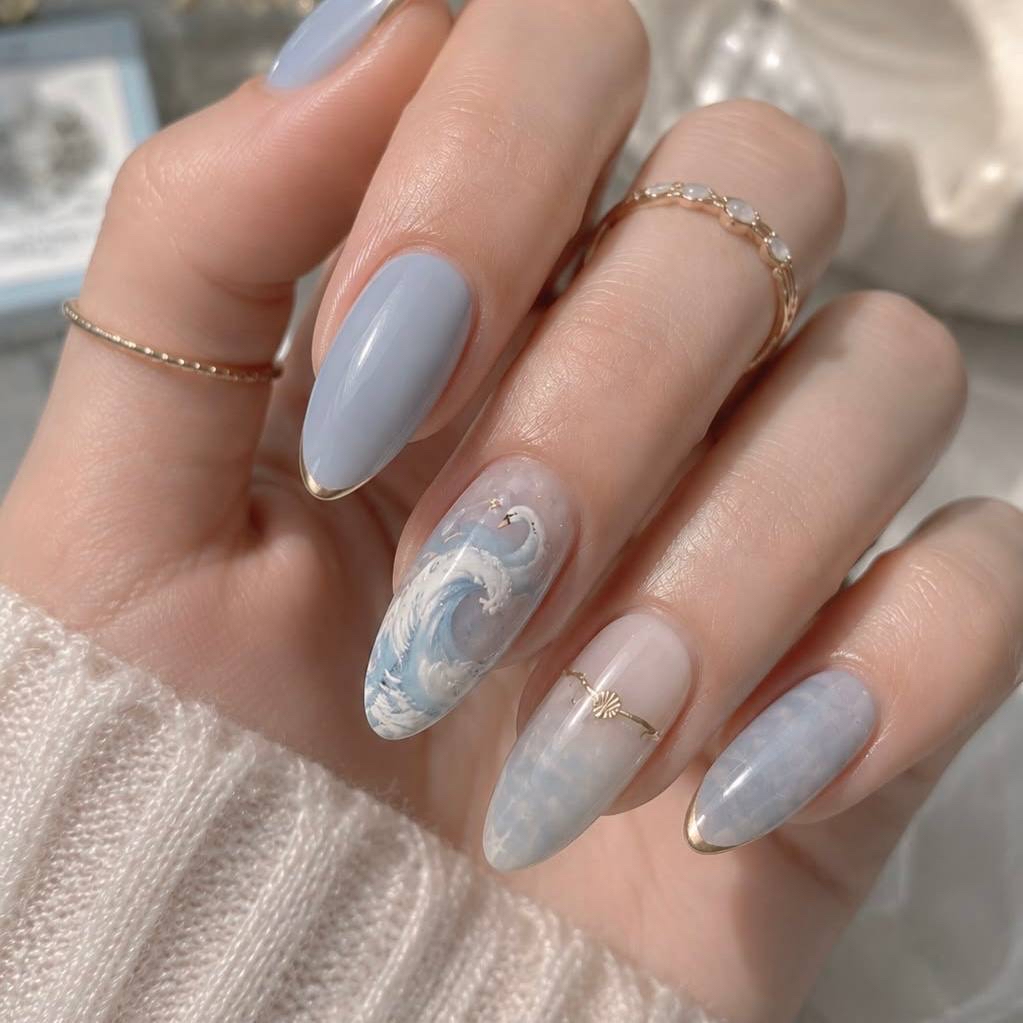
Aqueous watercolor nails are a technique centered on translucency and organic movement. Unlike traditional manicures that rely on high opacity and sharp, defined shapes, this style uses diluted pigments to create a marbled, wash-like effect on the nail bed. The finish is typically glassy and clear, mimicking the appearance of light passing through shallow water. By layering soft blues, whites, and perhaps a hint of seafoam green, the result is a pattern of swirling gradients and soft edges that look more like a painting than a standard polish application.
Behind the Trend
This trend arrives at a moment when the collective mood is shifting away from the highly structured and hyper-polished aesthetics of previous seasons. For a long time, the visual language of nails has been dominated by the “clean girl” aesthetic—a look defined by strict minimalism, beige tones, and perfectly uniform surfaces. While there is beauty in that precision, there is also a certain rigidity. There is also the recent surge of high-contrast chrome finishes and 3D textures that, while striking, can feel somewhat heavy or manufactured.
Aqueous watercolor nails offer a different path. They tap into a desire for something more naturalistic and expressive, leaning into the “softness” that defines the transition into spring. There is a subtle nostalgia here, too—a reminder of the quiet, meditative moments spent with a watercolor set in a classroom, watching how a single drop of blue pigment blooms across a damp sheet of paper. It is a move toward the organic, favoring the beautiful imperfections of nature over the sterile perfection of a factory-made finish.
By embracing these blurred lines, you are choosing a look that feels lived-in and effortless. It moves with your hands rather than sitting static upon them. It provides a sense of calm, acting as a small, wearable reminder of the fluidity found in the natural world, whether that is the movement of water or the shifting colors of a spring sky.
How to Get Aqueous Watercolor Nails
Achieving this look requires a departure from the standard “one coat and done” approach. To start, you will need a milky, semi-sheer base coat. This is essential because it acts as your canvas; a completely clear nail can make the colors look lost, whereas a milky base provides a soft, cloudy foundation that allows the subsequent layers to pop with depth. Once your base is set, the magic happens with the use of a highly diluted liquid gel or a sheer, water-like polish. You are looking for pigments that lack density, allowing them to flow easily across the surface.
When you begin the application, use a fine detail brush to pick up a tiny amount of your chosen color. Instead of painting a solid stripe, use a feathering motion to swirl the pigment onto the milky base. Think of it as dancing with the brush rather than pressing it down. You want to create irregular, sweeping shapes that mimic the movement of clouds or tide pools. If you find the color is becoming too concentrated in one area, a clean, damp brush can be used to gently blur the edges, encouraging the pigment to bleed softly into the surrounding space.
Patience is the most important element of this technique. Two very thin, translucent layers will read much more true-to-trend than one thick application. A single thick layer will result in a heavy, opaque look that destroys the watercolor illusion. By building the color through successive, whisper-thin washes, you create a sense of three-dimensional depth, as if the colors are suspended within the nail itself. Finally, seal the entire look with a high-shine, glass-like top coat. This provides the essential “wet” finish that completes the aqueous illusion, making the nails look as though they have just emerged from a clear spring.
For those who want to take this look a step further, consider adding a touch of gold leaf or a few tiny, iridescent pearls to a single accent nail. This adds a hint of “mermaidcore” sophistication without overwhelming the delicate, airy nature of the overall manicure.