Try the Coquette Floral Nail Trend for the Dreamiest Spring Manicure
A soft, romantic look we’ll be wearing all season.
The air is cool and carries the scent of damp earth and crushed jasmine. You are leaning back in a wrought-iron chair on a shaded veranda, a porcelain cup of Earl Grey warming your palms. Around you, the garden is waking up in a blur of pale peonies and wild ivy, and the only sound is the distant hum of a bumblebee wandering through a hedge of white roses. Everything feels slow, intentional, and draped in a kind of vintage softness, like a linen dress that has been washed a hundred times until it feels like a second skin.
You likely aren’t spending your Tuesday morning in a cottage garden in the English countryside, but that doesn’t mean you can’t carry that specific, airy atmosphere with you. The same sense of whimsical femininity and quiet romance can be translated directly to your fingertips. By shifting away from the starkness of winter tones and embracing a more ornate, delicate palette, you can capture that garden-party feeling with a manicure.
What Are Coquette Floral Nails?
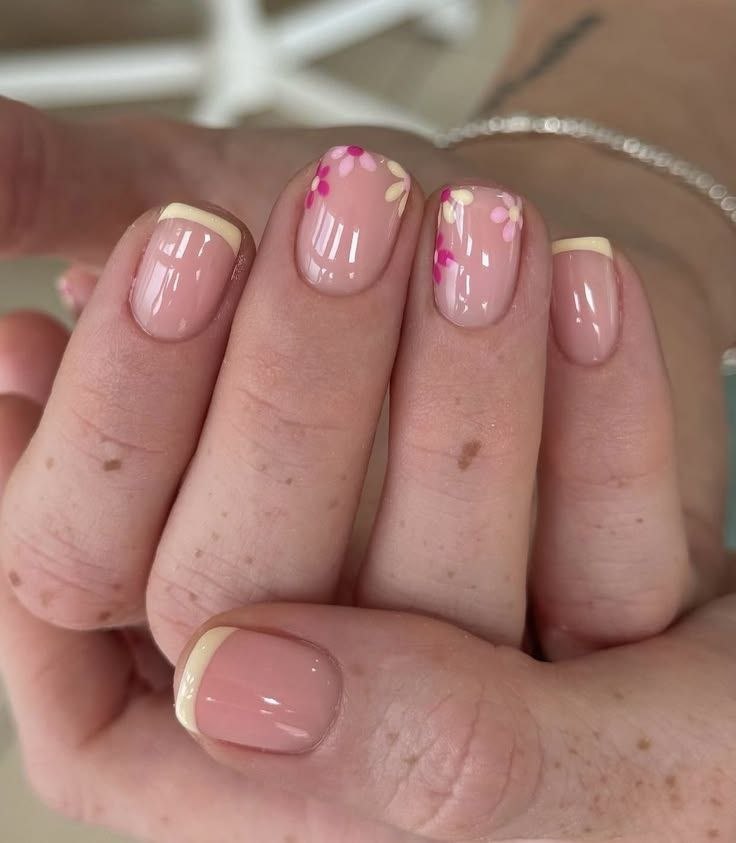
Coquette floral nails are defined by a combination of translucency and precise, miniature artistry. The look begins with a sheer, jelly-like base—typically in a pale pink, peach, or nude—that allows the natural nail bed to show through, creating a glow rather than a flat block of color. Over this, tiny, hand-painted floral motifs are added, usually consisting of five small, rounded petals surrounding a central dot. These flowers are often paired with a very thin, off-white or cream-colored French tip, which frames the nail without the heavy contrast of a traditional white tip. The finish is always high-gloss, giving the nails a polished, glass-like appearance that mimics the sheen of a glazed ceramic vase.
Behind the Trend
This aesthetic is resonating now because it represents a shift toward hyper-femininity and a desire for soft, tactile beauty. For a few seasons, the nail world was dominated by the clean girl aesthetic—think sheer, almost invisible polishes and a focus on extreme minimalism. While that look provided a sense of order and polish, it often felt a bit sterile. Coquette floral nails take that same foundation of cleanliness but add a layer of playfulness and sentimentality. It is a move from the clinical to the romantic.
When compared to other current trends, like the futuristic metallic sheen of chrome nails or the moody, dark depths of velvet magnetic polish, the coquette look feels like a breath of fresh air. Chrome is about the future and the digital world; velvet is about luxury and mystery. Coquette nails, however, are rooted in a specific kind of nostalgia. They evoke memories of childhood tea parties, vintage postcards, and the delicate lace collars of a bygone era. In a fast-paced digital environment, there is a genuine pull toward something that feels handcrafted and fragile, a small reminder of a slower, more ornate way of living.
How to Get Coquette Floral Nails
To achieve this look, you will need a few specific product categories: a sheer pink or nude polish, a pale cream polish, a fine-liner brush or dotting tool, and a high-gloss top coat. Start by applying two thin coats of the sheer polish. Using a sheer formula is essential here; if the color is too opaque, you lose the translucent, skin-like glow that makes the trend feel light and airy. Two thin layers read more true-to-trend than one thick layer, as they allow the natural nail to breathe through the color.
Once the base is dry, focus on the tips. Using a pale cream polish and a thin brush, draw a narrow smile line across the free edge of the nail. The key is restraint—the line should be a whisper of color, not a bold stripe. This soft contrast provides a structured frame for the art that will follow. If the line is too thick, you can easily clean the edge with a small brush dipped in acetone to keep the silhouette sharp and delicate.
The floral art is where the manicure comes to life. Using a fine-liner brush or a dotting tool, dip into an opaque white or pastel pink polish. Press the tool gently onto the nail to create five small, equidistant dots in a circular pattern. The size of the dots should be minimal, leaving a tiny gap in the center. To finish the flower, place a single dot of a contrasting color—such as a deeper rose or a soft yellow—right in the middle of the petals. Scatter these flowers organically across the nail; placing one or two near the cuticle and another drifting toward the side of the nail creates a more natural, vine-like flow than a centered, symmetrical placement.
Finally, seal everything with a generous layer of high-gloss top coat. This is a critical step because the hand-painted dots can create a slightly uneven texture on the nail surface. A thick, glossy sealant levels out the polish and protects the art, providing that reflective, porcelain finish that ties the entire look together.
For those who want to take the look a step further, you can add a single, tiny 3D pearl or a miniature bow charm to the ring finger. This adds a tactile element to the manicure, turning the nails into a piece of jewelry. Alternatively, you can swap the sheer pink base for a milky white to create a more ethereal, cloud-like effect that transitions perfectly from the peak of spring into the heat of summer.