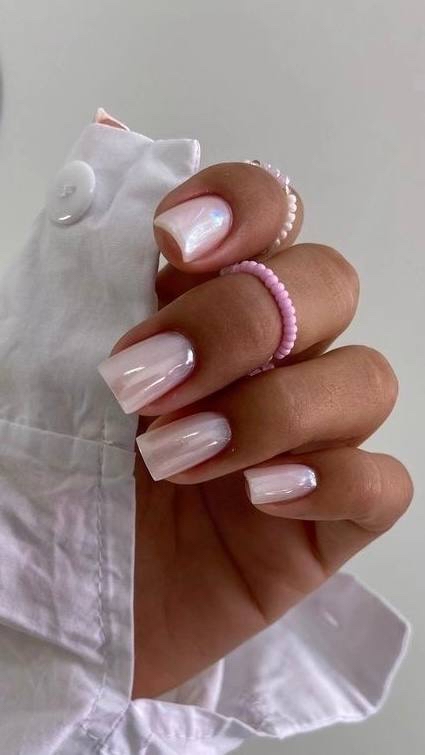
Try the Sorbet Gradient Trend for the Sweetest Spring Manicure
We’ll be wearing it all season.
The air carries a specific kind of weight in late April, a humid warmth that smells of freshly cut grass and the faint, citrusy tang of a lemon zest being peeled in a kitchen nearby. You find yourself sitting on a sun-drenched porch, watching the way the light filters through the budding leaves, creating moving patterns of gold and shadow on the wooden floorboards. There is a stillness to the moment, broken only by the sound of a distant ice cream truck and the rhythmic clink of ice against a glass.
You may not be sitting on a porch with a melting citrus treat in hand right now, but you can bring that exact sense of soft, sun-soaked warmth to your fingertips. The colors of a melting sorbet—those blurred, bleeding edges of peach, lemon, and strawberry—are moving from the dessert bowl to the manicure salon.
What Are Sorbet Gradient Nails?
Sorbet gradient nails are defined by a soft, translucent finish that mimics the appearance of jelly or fruit-based frozen desserts. Instead of the sharp, decisive lines found in traditional French manicures or color-blocked nail art, this trend relies on a diffused, airbrushed effect. The palette consists of sheer, milky pastels—think buttery yellows, soft petal pinks, and pale apricot—applied in a way that allows the colors to melt into one another. The texture is smooth and glass-like, often using jelly-based polishes that allow light to pass through the pigment, creating a sense of depth rather than a flat, opaque layer of color.
Behind the Trend
After several seasons of the “clean girl” aesthetic, which prioritized stark whites, sheer nudes, and highly disciplined minimalism, there is a visible shift toward something more playful and tactile. While the minimalist trend focused on looking polished and untouchable, the sorbet gradient feels approachable and nostalgic. It sits in the sweet spot between the loud, saturated neon trends of previous years and the quiet, neutral palettes that have dominated recent months. It offers color without the aggression of a solid primary shade.
This movement taps into a collective desire for softness. There is a certain comfort in the color stories of childhood summers—the hues of a watercolor painting or the melting edges of a popsicle. It feels less like a fashion statement and more like a seasonal ritual, a way to signal the transition from the heavy, dark tones of winter to the light, airy textures of spring. By mixing solid pastel nails with ombré versions of the same colors, the look gains a curated, intentional feel that avoids looking too uniform or repetitive.
How to Get Sorbet Gradient Nails
Achieving this look at home or in a salon requires a focus on translucency and patience. You will first need to start with a clean, well-buffed nail plate to ensure the light can reflect evenly through the sheer layers. A clear base coat is essential, but avoid anything too thick, as you want the subsequent layers to remain lightweight. If you are working with traditional polish, seek out the jelly or sheer category; these formulas are specifically designed to be built up in thin, translucent veils rather than a single heavy coat.
To create the gradient effect, you will need a small, dense makeup sponge or a specialized gradient sponge tool. Begin by applying a single, very thin coat of your first color—perhaps a pale yellow—to the entire nail. Once dry, apply your second color, such as a soft pink, only to the tip of the nail. While the pink is still slightly tacky, take your sponge and gently dab the area where the two colors meet. Use a light, bouncing motion to blur the line between the yellow and the pink. The key is to work in increments; two or three very thin, diffused layers will read more true-to-trend than one thick application that attempts to force opacity. If the transition looks too harsh, dab a tiny amount of your base color or a sheer white over the junction to soften the edge further.
For those who want to lean into the more decorative side of the trend seen in recent editorial looks, you can incorporate small, crystal-like accents. Using a tiny dot of nail adhesive, you can place a row of micro-rhinestones along the cuticle line of a solid-colored nail. This creates a beautiful contrast between the soft, blurred colors of the ombré nails and the structured, sparkling detail of the accent nails. To finish, a high-shine top coat is non-negotiable. A glossy finish enhances the jelly-like quality of the pigment, making the colors look as though they are suspended in glass.
If you find yourself wanting to experiment further, try adding a dusting of fine, iridescent shimmer over the gradient while the top coat is still wet. This provides a subtle, pearlescent glow that mimics the way sunlight hits a frost-covered fruit, giving the manicure a multidimensional, ethereal quality that lasts well into the summer months.