Try the Ribbed Jelly Nail Trend for the Dreamiest Spring Manicure
A tactile twist on your favorite sheer hues.
The air carries a specific kind of weight in the early morning of a coastal spring. It is a heavy, salt-misted humidity that clings to the skin and turns the sunlight into something thick and gold. You find yourself watching how the light passes through a glass of iced water on a garden table, noticing how the liquid doesn’t just sit there, but bends and refracts the world around it, turning the green of the leaves into shimmering, distorted ribbons of emerald.
You might not be sitting in a sun-drenched garden right now, perhaps you are navigating a morning commute or sitting at a desk under fluorescent lights, but you can carry that sense of luminous, watery depth with you. There is a way to capture that specific, liquid movement and bring it to your fingertips.
The sensation of light moving through water is something that feels inherently calm, and it is that exact feeling that is currently manifesting in the world of manicure trends. Moving away from the flat, high-shine surfaces of previous months, there is a new fascination with texture and translucency that feels more organic and sculptural.
What Are Ribbed Jelly Nails?
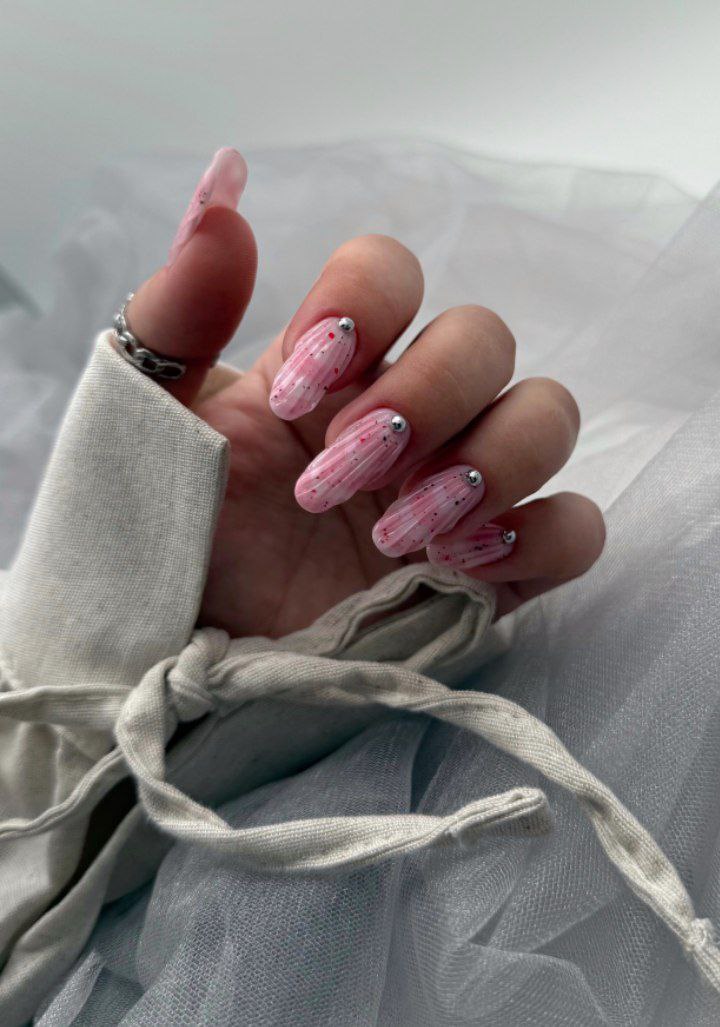
Ribbed jelly nails are a multi-dimensional manicure style that combines a semi-translucent, pigment-light base with raised, three-dimensional textures. The foundation of the look is a jelly polish—a category of lacquer or gel that lacks the heavy opacity of traditional cream polishes, allowing light to pass through the color much like stained glass. The “ribbed” element is achieved by applying a thicker, viscous product, such as a builder gel, in fine, linear patterns across the nail surface. This creates a tactile, ridged finish that catches the light at different angles, creating a play of shadow and highlights that shifts as you move your hands.
Behind the Trend
This trend is emerging as a sophisticated response to the heavy, metallic dominance of the chrome and “glazed” aesthetics that have defined much of the recent nail landscape. While chrome finishes aim for a mirror-like, impenetrable surface, ribbed jelly nails lean into a softer, more ethereal vulnerability. It is a shift from the “liquid metal” look toward something that feels more elemental and grounded in nature. If chrome is the high-shine finish of a polished car, jelly nails are the soft, diffused light of a sunset through a sea-glass window.
There is also a subtle sense of nostalgia embedded in this texture. The tactile ridges and the translucent colors evoke the feeling of childhood treasures—smooth sea glass found on a beach, or the cool, heavy weight of colorful glass marbles held in a warm palm. In a digital age where so much of our visual experience is flat and pixelated, there is a growing desire for things that feel dimensional and sensory. This trend offers a way to bridge the gap between minimalist beauty and expressive, almost sculptural art, providing a manicure that feels curated rather than merely applied.
By focusing on how light interacts with a surface rather than just the color itself, this trend allows for a much more nuanced approach to seasonal color. You aren’t just choosing a shade of pink; you are choosing how that pink lives and breathes under the light. This makes it a particularly versatile trend that can transition from the soft pastels of spring into the deeper, more saturated tones of late summer without losing its essential character.
How to Get Ribbed Jelly Nails
Achieving this look requires a departure from the standard “coat and go” method, as it relies heavily on layering different viscosities of product to create depth. You should begin with a perfectly prepped nail surface, ensuring the cuticle area is clean and the nail plate is smooth. The first step is to apply your base color using a sheer jelly polish. When working with this category of product, remember that two thin, even coats will read more true-to-trend than three heavy coats. You want to maintain that sense of translucency; if the color becomes too opaque, you lose the “glass” effect that makes the trend work. Choose a soft, watery hue like a pale peach, a translucent lilac, or a blush pink to keep the look light and airy.
Once your jelly base is cured or dry, you will move into the structural phase of the manicure. You will need a clear builder gel or a very high-viscosity clear gel to create the ridges. This is where the sculptural element comes into play. Using a fine-detail liner brush, dip into the clear gel and begin to draw thin, vertical lines starting from the cuticle area and moving toward the free edge. The key is to maintain a rhythmic, consistent spacing between the lines. Because the gel is thicker, it will sit on top of the color rather than soaking in, creating those raised ridges. You can experiment with the density of the lines; tighter lines will create a more textured, ribbed feel, while wider spacing will feel more minimalist and modern.
For those who want to add a layer of complexity, this is the moment to introduce subtle details. You might use a tiny dotting tool to place microscopic flecks of color or fine glitter into the jelly base before you apply the clear ridges, creating a sense of suspended particles within the “liquid.” To add a touch of structural contrast, as seen in many contemporary interpretations, you can place a single, small metallic silver stud or a tiny gold bead at the base of each nail near the cuticle. This breaks up the softness of the jelly with a hard, reflective element. Finally, seal the entire design with a high-shine top coat. The top coat is essential not just for durability, but to ensure that the ridges are smooth to the touch and that the light can glide over the surface without snagging, fully realizing the luminous, glass-like finish you are aiming for.
If you find yourself drawn to even more dramatic versions of this look, try playing with color contrast. Instead of a monochromatic approach, you can use a slightly darker jelly polish for the ridges themselves, or even a sheer white jelly to create a “milky” effect that mimics the appearance of frozen sea glass.