Try the Butter Yellow Nail Trend for the Softest Spring Manicure
A creamy hue we’ll be wearing all season.
The morning air carries a specific, crisp weight, the kind that suggests the frost has finally retreated. You are sitting on a wrought-iron chair at a small corner café, the surface of the table slightly cool beneath your palms. Beside you, a plate of toasted brioche glows under the filtered sunlight, and the scent of steamed milk and citrus zest lingers in the breeze. There is a quietness to the hour, a sense of slow awakening where the colors of the world seem to shift from the heavy grays of winter into something lighter, more permeable, and inherently optimistic.
You likely aren’t spending your Tuesday morning at a sidewalk bistro, but the mood of that moment—the softness, the warmth, the feeling of a fresh start—is something you can carry with you. It is a specific frequency of light and color that translates perfectly to your fingertips. If you are looking for a way to signal the change in season without leaning into the predictable tropes of floral prints or bright neons, you can get the look with a butter yellow manicure.
What Are Butter Yellow Nails?
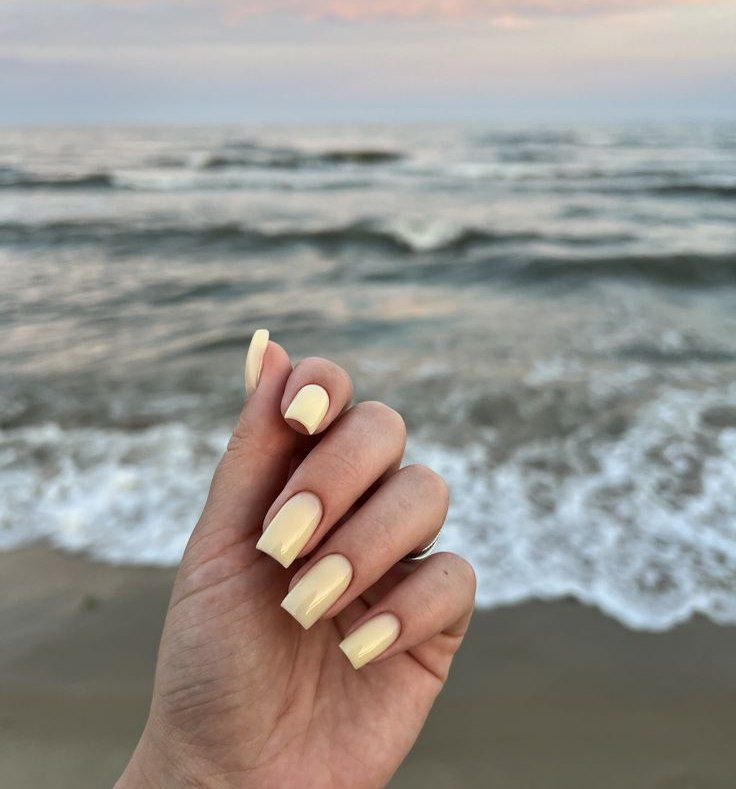
Butter yellow nails are defined by a low-saturation, opaque pigment that sits exactly between a pale pastel and a neutral cream. Unlike a primary yellow, which can feel sharp or industrial, this shade possesses a milky quality that softens the edges of the color. The finish is typically a high-shine gloss that mimics the look of polished ceramic or heavy cream, though it can be adapted to a satin finish. It is a pigment that reads as warm rather than cool, providing a subtle glow that complements a wide range of skin undertones without creating the harsh contrast associated with brighter citrus tones.
Behind the Trend
This shift toward butter yellow reflects a broader movement in the beauty space away from the high-contrast, high-maintenance aesthetics of previous years. For a long time, the clean girl aesthetic relied heavily on stark, milky whites or sheer, glass-like nudes. While those looks remain staples, there is a growing desire for something that feels more human and less clinical. Butter yellow fills this gap by offering the same versatility as a neutral, but with an intentional injection of warmth. It provides a sense of coziness and approachability that a sterile white simply cannot achieve.
When compared to the holographic or metallic chrome trends that dominated recent months, butter yellow feels like a return to something tactile and organic. Chrome nails are about the future and the digital world; butter yellow is about the garden, the kitchen, and the physical sensations of spring. There is a genuine nostalgia tied to this color, evoking memories of childhood sundresses, lemon-curd tarts, or the pale light of a nursery. It taps into a collective longing for simplicity and a slower pace of life, making it feel less like a fleeting fashion choice and more like a seasonal ritual.
How to Get Butter Yellow Nails
Achieving this look requires a focus on opacity and smooth application to avoid any streaking, which can happen easily with yellow pigments. Begin with a thorough nail prep, pushing back your cuticles and buffing the nail plate to create a level surface. Apply a high-quality base coat; this is a non-negotiable step for this specific color, as yellow pigments can sometimes stain the natural nail if applied directly. The base coat acts as a barrier and ensures the color glides on without skipping.
For the color, you will need a cream-based yellow polish. Avoid anything labeled as sheer or neon, as these will not provide the necessary depth of color. Apply the first coat in three steady strokes: one down the center and one on each side. Do not worry if the first layer looks slightly translucent or uneven; the goal is to establish the base without building up too much thickness. Let the first coat dry completely before applying a second. Two thin coats read more true-to-trend than three thick ones, which can lead to bubbling or a look that feels too heavy for the softness of the color.
The finish is where the manicure comes together. Use a high-gloss top coat to lock in the color and provide that characteristic ceramic sheen. This not only protects the polish from chipping but also enhances the vibrancy of the yellow, making it look creamy rather than flat. If you are working from home, a quick-dry top coat is the most efficient choice, but for a professional-grade finish, a gel top coat cured under a lamp provides the most longevity and a mirror-like reflection.
To finish the process, apply a small amount of cuticle oil to the surrounding skin. Because butter yellow is such a clean, polished color, any dry skin around the nail becomes more noticeable. Hydrating the area ensures the focus remains on the color and the smooth transition from the skin to the nail plate.
If you want to take the look a step further, consider a subtle variation such as a matte top coat, which transforms the buttery shine into a soft, velvet-like texture. For those who want a bit more detail, adding a single, tiny white dot or a thin white line at the base of the nail can create a modern, minimalist take on the French manicure while keeping the warmth of the yellow intact.