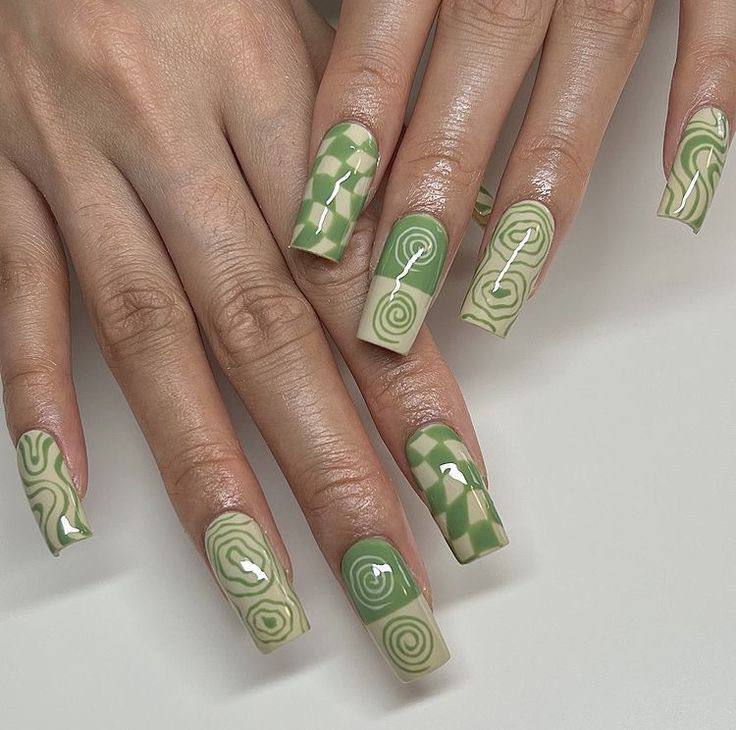
The shift toward muted, botanical colorways in recent manicure trends suggests a collective desire for a more grounded aesthetic. As the season transitions, the saturation of neon and bright primaries tends to give way to more contemplative tones. The current fascination with sage green, particularly when interlaced with both geometric checkerboard and organic swirl motifs, offers a sophisticated way to engage with pattern without overwhelming the hand. This specific combination works because it balances the mathematical precision of the grid with the fluid, unpredictable nature of hand-painted lines.
The Aesthetic Logic of Sage and Cream
The success of this look relies heavily on the relationship between the chosen pigments. Sage green functions as a versatile neutral, offering enough color to be noticed while remaining subtle enough to complement a wide variety of skin undertones. By pairing it with a soft, milky cream or an alabaster base, you avoid the high-contrast tension that often makes checkerboard patterns look juvenile. Instead, the colorway feels curated and intentional.
When selecting your polishes, consider the finish. A cream finish provides a solid, opaque base that makes the patterns pop with clarity. However, if you prefer a more ethereal appearance, opting for a jelly-finish sage can add a sense of depth, as if the pigment is suspended within the nail. This translucency allows light to interact with the layers of color, creating a more multidimensional effect that mimics natural stones or sea glass.
Masterful Patterns: Checkerboard Meets Swirl
Executing these dual patterns requires a thoughtful approach to tool selection and hand stability. If you are performing this application at home, a fine-tipped liner brush is your most important instrument. For the checkerboard sections, the goal is to create clean, intersecting lines. You should map out your grid with a very light touch, ensuring the lines do not pool at the intersections, which can create unsightly ridges.
The swirl designs require a different kinetic energy. Rather than the rigid control used for the grid, swirls demand a rhythmic, sweeping motion. Start by placing a small dot of pigment near the center of the nail and pull the brush outward in a continuous, spiraling motion. To achieve the look seen in contemporary editorial photography, the swirls should feel organic, almost like topographical map lines. If your lines are not perfectly symmetrical, do not attempt to correct them mid-stroke; the beauty of the swirl lies in its movement, and slight irregularities actually enhance the hand-painted, artisanal quality of the design.
Structural Foundations and Shape Selection
The canvas for these intricate designs is just as important as the pigment itself. A long coffin or tapered square shape provides the necessary vertical real estate to display both the geometric and the organic patterns without them feeling cramped. The length allows the viewer’s eye to follow the curves of the swirls or the repetition of the checkerboard, making the art feel like a cohesive part of the nail’s architecture.
When you visit a professional, emphasize the importance of apex placement. A well-constructed manicure needs a central point of strength, typically achieved through the strategic application of builder gel. This ensures that despite the length of the nail, the structure remains resilient against daily wear. A technician who understands how to balance the sidewalls and reinforce the apex will ensure that your intricate art remains intact, preventing the cracks or chips that can quickly ruin a detailed design.
The Visual Impact of Texture and Maintenance
While a high-shine top coat is the standard for this look, you can manipulate the aesthetic by playing with texture. A glass-like, high-gloss finish emphasizes the cleanliness of the checkerboard and makes the colors appear more saturated. Conversely, a velvet matte top coat can transform the sage green into something that feels more like fine stationery or heavy linen, leaning into a more muted, tactile experience.
To maintain the integrity of the design, consistent care is required. The most effective way to preserve the crispness of your lines is to protect the nail’s edges. Applying a nourishing cuticle oil barrier daily is not merely for skin hydration; it prevents the polish from becoming brittle at the free edge, which is where many designs begin to fail. By keeping the surrounding skin hydrated and the top coat smooth, you extend the lifespan of the manicure and ensure the colors remain as clear as the day they were applied.
You can approach this aesthetic with a sense of calm precision, whether you are working with a professional or practicing your linework at your own vanity. It is a design that rewards attention to detail and a respect for the balance between order and movement.